Voicemail drop is technology that allows outbound callers to leave a pre-recorded audio message in a contact's voicemail inbox — either without the phone ringing at all, or by detecting voicemail during a live dialing session and pressing a button to deliver the message. It is used in sales and contact center contexts to increase reach efficiency: agents can cover more contacts per hour when voicemail handling is automated rather than requiring each agent to wait through a voicemail greeting and record a custom message on every unanswered call.
The technology sounds simple. The regulatory dimension is not. In 2022, the FCC issued a Declaratory Ruling that ringless voicemails are "calls" under the Telephone Consumer Protection Act (TCPA), bringing the full weight of TCPA consent requirements to bear on a technology that some operators had previously treated as a compliance gray area. This article covers how voicemail drop works mechanically, the two distinct delivery methods, and the regulatory context that any organization using it needs to understand before deploying. This article provides general information, not legal advice — consult legal counsel before deploying voicemail drop for outbound marketing or any regulated use case.
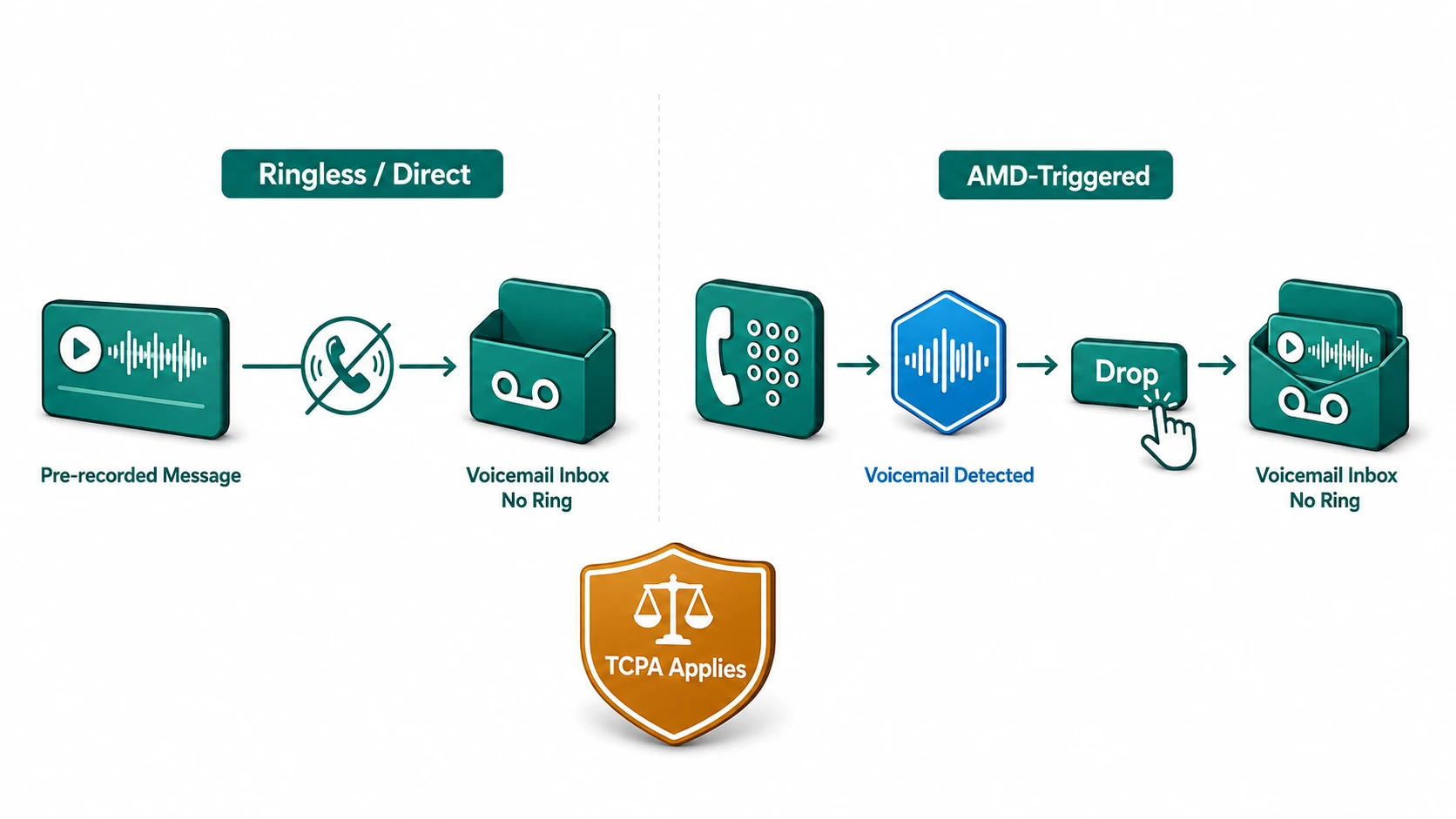
Definition: Voicemail drop is an outbound communication method that deposits a pre-recorded audio message directly into a recipient's voicemail inbox. There are two distinct delivery methods: drop-on-AMD (triggered by an agent during a live dialing session when AMD detects voicemail) and ringless voicemail (server-to-server delivery that bypasses the ringing phase entirely). Both methods are subject to TCPA regulation following the FCC's November 2022 Declaratory Ruling.
The Two Delivery Methods
Understanding the technical distinction between the two delivery methods matters because they work differently, involve different system components, and have slightly different regulatory profiles.
Method 1: Drop-on-AMD (Agent-Triggered)
In this method, the outbound dialer places a call normally — the recipient's phone rings. If the call is answered by a voicemail system rather than a live person, AMD (Answering Machine Detection) identifies the voicemail greeting. At that point, either the system automatically deposits the pre-recorded message, or an agent monitoring the call sees the AMD classification and clicks a "drop voicemail" button. The pre-recorded audio plays into the voicemail system's recording buffer, the call disconnects, and the system (or agent) moves to the next contact.
In the agent-triggered variant, the agent is not recording a new message each time — they select from a library of pre-recorded messages relevant to the campaign and click once. This means a single agent can handle voicemail-detected calls for an entire predictive or power dialing session without spending time per call recording anything.
The phone rang in this method. The voicemail answered. The deposited message is pre-recorded audio. This matters for TCPA analysis because the call follows the standard phone-ringing model; it is the content (pre-recorded artificial voice) that is regulated, not a novel delivery mechanism.
For more on how AMD works and its accuracy trade-offs, see what is answering machine detection.
Method 2: Ringless Voicemail (RVM)
Ringless voicemail bypasses the ringing phase entirely. Instead of placing a traditional phone call, the system delivers the audio message directly to the carrier's voicemail server using server-to-server protocols or SIP techniques. The recipient's phone never rings. The message simply appears in their voicemail inbox as a missed voicemail from the sending number.
From the recipient's perspective, they look at their phone and see a voicemail notification from an unknown number — without having heard a ring or made any decision about answering. This is the characteristic that attracted both business interest (high reach, no answer-rate dependency) and regulatory scrutiny (no opportunity for the recipient to decline the contact).
The technical implementation of ringless voicemail varies. Some systems use carrier-level agreements for direct server-to-server injection. Others use VoIP techniques where the call is initiated but configured to send directly to voicemail before generating a ring signal at the handset. The specifics depend on carrier agreements and the technical architecture of the RVM platform.
The Regulatory Picture
Important: The regulatory landscape for voicemail drop has changed materially. The information below reflects the legal framework as of mid-2026, but TCPA regulations, FCC rulings, and state laws evolve. This is general information, not legal advice. Consult legal counsel before designing or deploying any voicemail drop program.
TCPA and the 2022 FCC Declaratory Ruling
For years, some operators argued that ringless voicemail was not a "call" under the TCPA because it did not cause a phone to ring. In November 2022, the FCC issued a Declaratory Ruling making clear that ringless voicemail messages are "calls" under the TCPA. This ruling settled the most significant compliance ambiguity that had made ringless voicemail attractive as a regulatory workaround.
The consequence: TCPA consent requirements apply to ringless voicemail. For marketing or promotional messages delivered to cell phones, TCPA requires prior express written consent — explicit, documented opt-in from the recipient. For purely informational messages (account notifications, appointment reminders from established business relationships), prior express consent may be sufficient, though the distinction between informational and marketing content is often scrutinized in litigation.
Drop-on-AMD voicemail — where the phone rang and the call was placed in the conventional sense — involves a pre-recorded message delivered using an artificial voice. TCPA's prerecorded message rules apply to telemarketing calls using artificial or pre-recorded voice, requiring prior express written consent for cell phone marketing messages. The fact that the phone rang first does not change the consent analysis for the pre-recorded content.
AI-Generated Voice in Voicemail Drops
In February 2024, the FCC issued a ruling clarifying that calls using AI-generated voices are subject to TCPA requirements regardless of whether a human initiated the call. If your voicemail drop messages use AI-synthesized voice rather than a human recording, this layer of regulation applies. The consent requirements are the same, but the ruling adds regulatory clarity that AI-generated voice is not a mechanism to avoid TCPA applicability.
FTC Telemarketing Sales Rule
The FTC's Telemarketing Sales Rule (TSR) applies to prerecorded telemarketing messages and prohibits, among other things, delivering a prerecorded sales message to a consumer who has not expressly agreed in writing to receive such calls. The TSR operates alongside TCPA requirements and is enforced by the FTC rather than the FCC.
DNC Compliance
Numbers registered on the National Do Not Call Registry cannot be called for marketing purposes without prior express consent from that specific consumer, regardless of the delivery method. Voicemail drop to a DNC-registered number is subject to the same scrubbing requirements as any other outbound telemarketing call. For the full DNC compliance framework, see what is the DNC registry.
State Laws
Several states have enacted their own consumer protection statutes that go beyond federal TCPA and TSR requirements. Some state-level laws impose stricter consent requirements, apply to more categories of calls, or establish different definitions of what constitutes a telemarketing communication. Organizations operating nationally should assess state law requirements in the states where they are calling.
Business Use Cases
Within a compliant framework — with appropriate consent, DNC scrubbing, and applicable disclosures — voicemail drop has legitimate business applications:
- Appointment reminders — healthcare practices, service businesses, and similar organizations reminding established customers of upcoming appointments, subject to consent requirements applicable to their relationship type
- Re-engagement campaigns — reaching out to past customers who have opted in to future contact, using drop-on-AMD to leave a message when the call goes unanswered
- Outbound sales follow-up — leaving a callback message when a warm lead does not answer, for contacts where prior express written consent to marketing calls has been obtained
- Service notifications — utility outages, delivery status updates, or similar informational messages to customers with whom the business has an established relationship, subject to the informational vs. marketing distinction and applicable consent standards
Debt collection voicemail drops involve additional regulatory layers under the Fair Debt Collection Practices Act (FDCPA), which governs how third-party debt collectors may communicate with consumers. Businesses operating in debt collection contexts should consult legal counsel specifically on FDCPA requirements as they apply to voicemail messages.
Operational Considerations
Beyond the regulatory questions, voicemail drop has practical operational implications worth evaluating before deployment:
- Message quality — pre-recorded messages cannot adapt to context. A message recorded for a general re-engagement campaign will reach contacts at different stages of the funnel with the same content. Segmenting message libraries by campaign type and contact history improves relevance.
- AMD accuracy — drop-on-AMD depends on AMD correctly identifying voicemail. False positives (live person classified as voicemail) result in a pre-recorded message playing to a live caller — a poor experience that can generate complaints and TCPA exposure if the call was to a cell phone without appropriate consent. Modern AMD systems achieve roughly 85–95% accuracy, meaning a small percentage of live-answer drops will occur at scale. See what is answering machine detection.
- Callback volume — a successful voicemail drop campaign generates inbound callbacks. Ensure inbound capacity — call queues, agent availability, and routing — is configured to handle the return volume. See what is a call queue.
- Number reputation — high-volume voicemail drops from a single number can trigger spam labeling by carrier analytics platforms, reducing the effectiveness of the campaign and harming the number's reputation for other outbound use.
Voicemail Drop vs. Standard Voicemail
From the recipient's perspective, a voicemail drop and a voicemail left manually by an agent are functionally identical — both appear as voice messages in their inbox. The operational difference is on the sender side: standard voicemail requires an agent to wait through each greeting and record a unique message; voicemail drop is a one-click operation (drop-on-AMD) or eliminates the ringing phase entirely (ringless). The efficiency gain is significant at scale — an agent using drop-on-AMD can handle voicemail-detected calls in a fraction of the time required to record a custom message, enabling higher contact rates per agent-hour on outbound campaigns.
The regulatory requirements apply regardless of whether the message was deposited efficiently via a click or left manually. A pre-recorded message is a pre-recorded message under TCPA, regardless of the mechanism used to deliver it.