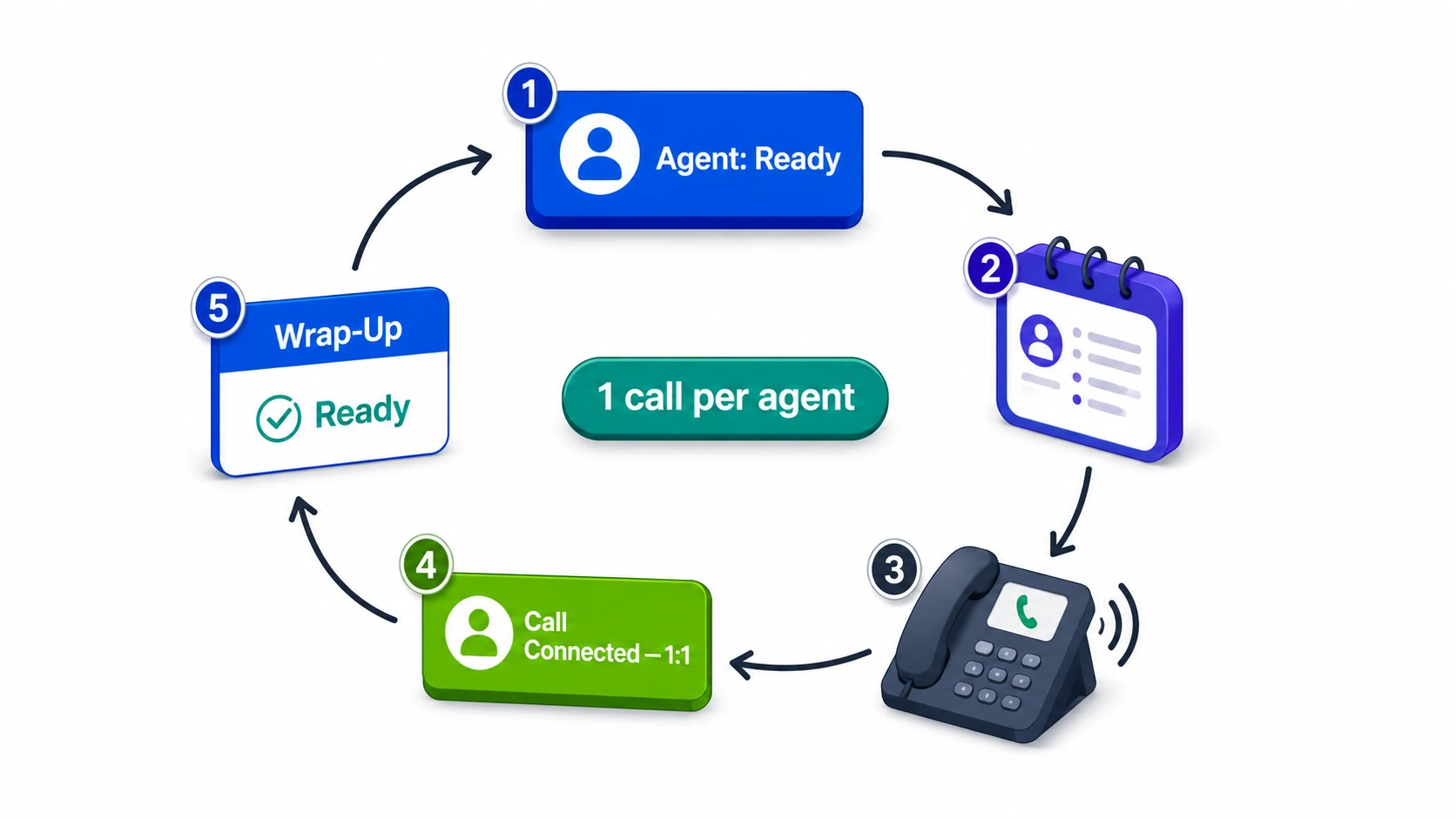
A power dialer automatically dials the next contact on a list as soon as an agent is ready — eliminating the time agents spend manually finding numbers, copying them into a phone, and initiating the call. Unlike a predictive dialer, which dials multiple numbers simultaneously and accepts some risk of abandoned calls, a power dialer places one call per agent at a time. The agent hears ringing, and connects when a live person answers. No complex pacing algorithm, no abandoned calls as a structural feature of the system.
Understanding where a power dialer fits means understanding the full spectrum of outbound dialing modes. This article covers how power dialing works mechanically, how it compares to predictive, progressive, and preview modes, who it serves best, and the compliance context that makes it a practical alternative to predictive dialing for many teams.
Definition: A power dialer is an outbound calling system that automatically initiates one call per available agent the moment they complete a call and return to ready status — or when the agent triggers the next dial. One agent, one call at a time. The system dials from a pre-defined contact list without requiring the agent to manually enter or select the number. Unlike predictive dialing, no call is placed without a ready agent, which means no structurally generated abandoned calls.
How Power Dialing Works
The mechanics are straightforward. An agent logs into the dialer platform and sets their status to Ready. The system identifies the next contact in the campaign list and dials that number. The agent hears the dialing audio — ringing, busy signal, or connection — through their softphone or headset.
When the call is answered, the agent is immediately connected. If AMD (Answering Machine Detection) is enabled, the system analyzes the answered call to determine whether a live person or a voicemail system picked up. For live answers, the agent is connected. For detected voicemails, the system can either drop a pre-recorded message and move to the next contact, or route based on configuration.
When the call ends — whether it was answered, went to voicemail, or was not answered — the agent enters wrap-up (logging the outcome, adding notes, selecting a disposition). Once the agent returns to Ready, the dialer automatically places the next call. The agent is never looking up a number or dialing manually; the only decisions they make are how to handle each conversation and what disposition to log.
Some implementations differ on one detail: whether the dialer begins ringing the next contact while the agent is still in wrap-up, so the call connects the moment the agent clicks Ready. This reduces the gap between calls but means the number is dialing before the agent has confirmed availability. This variant is functionally close to progressive dialing — the exact boundary between "power" and "progressive" is not universally standardized, and different vendors use the terms differently.
Power Dialer vs. Predictive Dialer
The core distinction is how many simultaneous dial attempts are placed per available agent:
- Power dialer: one dial attempt per agent. The system waits until the agent is available, then dials one number. No call goes out without a ready agent. Abandoned calls are not a structural feature.
- Predictive dialer: multiple simultaneous dial attempts per agent, driven by a pacing algorithm that models when agents will next be free. The algorithm accepts the statistical probability that some answered calls will find no immediately available agent — these become abandoned calls. The goal is to maximize agent talk time across the team.
The tradeoff is throughput versus compliance risk. A predictive dialer can produce significantly higher agent talk time per hour on large campaigns — particularly when answer rates are low and agents would otherwise wait several seconds between each dial attempt connecting. A power dialer sacrifices some of that throughput ceiling in exchange for zero structurally generated abandons and simpler compliance posture.
For teams with fewer than 7–10 simultaneously dialing agents, the predictive dialer's statistical model breaks down anyway — small pools have too much variance for the pacing algorithm to work reliably. Power dialing is often the more practical choice at small team scale. For a deeper look at predictive dialing mechanics and minimum team size requirements, see what is a predictive dialer.
Power Dialer vs. Progressive Dialer
The distinction between power and progressive dialing is less clear in practice, because vendors use the terms with significant overlap. In the most common definitional framing:
- Progressive dialer — waits for the agent to reach fully available/ready status before placing any call. One call per agent, no pre-dialing. Zero risk of connecting before the agent is ready.
- Power dialer — in some definitions, may begin dialing while the agent is in wrap-up so the connection is ready the instant the agent goes ready. Still one call per agent, but with a slight pre-dial overlap.
In practice, the terminology varies enough by vendor that you should verify the specific behavior of the platform you are evaluating rather than relying on the label. Predictive vs progressive vs preview dialers and what is a progressive dialer cover all three automated dialing modes and preview dialing in full.
Power Dialer vs. Preview Dialer
A preview dialer shows the agent the contact record before placing any call. The agent reviews the prospect's name, history, prior call notes, and any relevant context — then decides to place the call (or skip the contact). The dial only happens after the agent actively initiates it.
A power dialer dials automatically without a preview pause. The agent sees who is calling as the call connects or ringing begins, but there is no pre-call review window. This makes power dialing faster per contact than preview dialing, but preview dialing is more appropriate when the nature of the call requires agent preparation — high-value prospects, complex sales conversations, or situations where the agent needs to recall prior interaction history before speaking. For more on when agent-initiated dialing matters, see what is a preview dialer.
Full Dialer Mode Comparison
| Mode | Calls per agent | Abandoned calls | Agent preview | Best suited for |
|---|---|---|---|---|
| Preview | 1, agent-initiated | Zero | Yes — full record before dial | High-value, complex, or regulated calls |
| Power / Progressive | 1, auto-dialed | Zero | No — contact visible on connect | SMB sales, moderate volume, compliance-sensitive campaigns |
| Predictive | Multiple, algorithm-driven | Yes — must be managed | No | High volume, 10+ agents, lower-sensitivity lists |
The Compliance Picture
One reason power dialing is popular among teams with compliance awareness is the abandoned call question. A predictive dialer structurally generates some percentage of abandoned calls — calls where a live person answers and no agent is available. The FTC's Telemarketing Sales Rule caps abandoned calls at 3% of answered calls in telemarketing campaigns, and exceeding this is a regulatory violation with per-call penalties. See predictive dialer compliance for the full regulatory framework.
A power dialer does not have this structural abandon risk because it never places a call without a ready agent. This does not mean power dialing is exempt from all compliance requirements — TCPA consent rules, DNC list obligations, and call recording consent laws still apply. But the absence of abandoned calls removes one of the more complex compliance dimensions of predictive dialing.
One nuance worth noting: the post-Facebook v. Duguid SCOTUS decision (2021) narrowed the TCPA's definition of an Automatic Telephone Dialing System (ATDS) to systems that use random or sequential number generation. Power dialers that dial from pre-stored contact lists are generally not considered ATDSs under this narrower reading — which affects whether TCPA's prior express written consent requirement applies to cell phone calls placed by the dialer. However, TCPA litigation in this area is ongoing, state laws vary, and the regulatory picture is not fully settled. Businesses running outbound campaigns should consult legal counsel on their specific situation rather than relying on any general description of the law.
DNC list compliance remains mandatory regardless of dialer type. Before running any outbound campaign, numbers should be scrubbed against the national DNC registry and any applicable state registries. For DNC mechanics, see what is the DNC registry.
AMD in a Power Dialer Context
Power dialers typically support AMD (Answering Machine Detection) as an optional feature. When AMD is enabled, the system analyzes each answered call to determine whether a live person or a voicemail system picked up.
For live answers: the agent is connected. For voicemail detections: the system can either skip the contact and move on, log the attempt for a later callback, or drop a pre-recorded voicemail message (voicemail drop). Configuration options vary by platform.
AMD in a power dialer context introduces the same accuracy trade-off as in predictive dialing — roughly 85–95% accuracy under good conditions, with false positives (live person classified as voicemail) resulting in a missed live answer. Because the power dialer is placing one call at a time, a false positive means one wasted opportunity per incident rather than the compounding effect it can have in predictive campaigns. What is answering machine detection explains how AMD works technically.
Practical Example: 10-Agent Sales Team
A 10-person outbound sales team at a regional insurance agency makes calls to a warm lead list — people who have requested quotes online. The team values call quality: each contact took marketing spend to acquire, and agents need to have knowledgeable conversations about specific policy options based on the prospect's submitted information.
Using a power dialer integrated with their CRM: when Agent 3 finishes a call and logs the disposition, the system automatically dials the next qualified lead from the CRM queue. Agent 3's screen shows the prospect's name, the policy type they inquired about, and any prior contact notes as the call connects. The agent does not spend time manually dialing or selecting the next contact. AMD is enabled — voicemails are logged for automated follow-up, and the agent moves immediately to the next live-answer attempt.
Over an 8-hour shift, each agent handles roughly 2–3x more conversations than they would with manual dialing, without the abandon risk of predictive mode and with full context on each contact at connection.
When Power Dialing Is the Right Choice
- Teams under 10 agents — where predictive dialing's statistical model is unreliable and abandon rate management becomes difficult
- Warm or high-value lists — where a false positive or an abandoned call carries meaningful cost and a personal connection matters
- Compliance-sensitive campaigns — where avoiding the structural abandon risk of predictive dialing simplifies the compliance picture
- Sales contexts requiring agent readiness — where agents need to be present and focused at the moment of connection rather than processing across multiple simultaneous attempts
- Moderate-volume outbound — where the throughput ceiling of one-call-at-a-time is acceptable given list size and campaign duration