
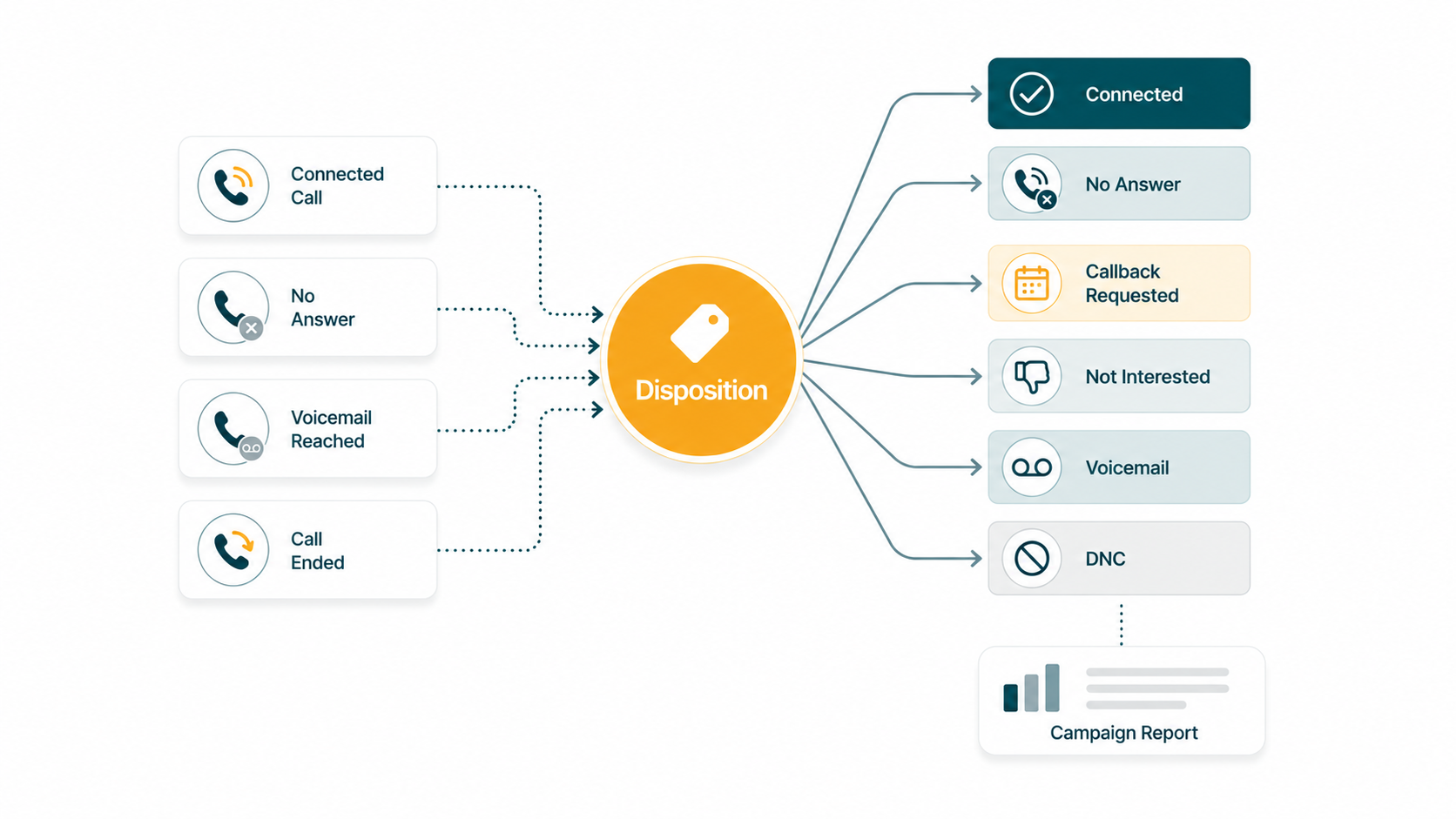
Every call ends. But a call that ends without its outcome being captured in a structured way produces no useful information for the next dial, the next agent, or the next campaign. Knowing that 10,000 calls were placed tells you almost nothing. Knowing that 2,400 connected to live humans, 620 requested callbacks, 180 asked to be added to the DNC list, 84 converted, and 410 were wrong numbers — that tells you where to focus.
Call dispositions are the mechanism that turns call outcomes into actionable data. They are structured labels attached to each call after it ends, classifying what happened so the information can drive decisions: who to call back and when, which numbers to remove from the list, how to measure agent performance, and how to assess campaign health.
What is a call disposition? A call disposition is a structured label assigned to a call after it ends — either by an agent during wrap-up time, or automatically by the dialing system — that classifies the outcome of that interaction. Dispositions transform individual call outcomes into structured data that can be aggregated for reporting, used for list management, and fed into downstream workflows like callback scheduling, DNC processing, and CRM updates.
Two Types of Call Disposition
Manual (agent-assigned) dispositions
Manual dispositions are selected by the agent after the call ends, during what is typically called wrap-up time — the period between the end of one call and the agent returning to ready status for the next. The agent reviews the outcome and chooses the appropriate label from a predefined list.
The quality of manual disposition data depends on the quality of the disposition list and agent training. A list with too many options creates inconsistency — agents choose different labels for similar outcomes, making reporting unreliable. A list with too few options forces agents to choose a "close enough" label, losing granularity. Well-designed disposition lists are specific enough to mean something but compact enough that agents can select consistently under time pressure.
In predictive dialing, wrap-up time is actively managed — the dialer may be placing the next call while the agent is still in wrap-up, so disposition selection needs to be fast. Some platforms set maximum wrap-up timers after which the agent is automatically returned to ready status, which creates pressure on disposition quality if the timer is too short.
Automated (system-assigned) dispositions
The dialing system assigns some dispositions without agent involvement, based on what the telephony infrastructure observed about the call:
- No Answer / Ring No Answer: The call rang but was not answered within the ring timeout
- Busy: The line returned a busy signal
- AMD / Voicemail: Answering Machine Detection classified the answer as a machine rather than a live human
- Invalid Number / Disconnected: The carrier returned a non-connectable signal (SIT tones, "number not in service" recordings, specific SIP error codes)
- Network Error / Failed: The call attempt failed due to a technical issue rather than a called-party action
Automated dispositions are applied instantly and require no agent action. They are particularly important in predictive and progressive campaigns where call volume is high and a large fraction of dial attempts will not result in a live conversation.
Common Disposition Categories
The specific disposition labels a call center uses vary by campaign type, industry, and platform configuration. There is no universal standard — a disposition list for a debt collection campaign looks different from one for a software sales campaign. The following categories are representative of what most outbound operations need:
| Disposition | Type | Typical follow-up action |
|---|---|---|
| Answered / Connected | Automated or manual | Update contact history; agent adds outcome sub-disposition |
| No Answer | Automated | Schedule retry at different time of day |
| Voicemail / AMD | Automated | Voicemail drop if configured; schedule retry; log attempt count |
| Busy | Automated | Retry after a short delay interval |
| Callback Requested | Manual (agent) | Create scheduled callback task, optionally assigned to same agent |
| Not Interested | Manual (agent) | Suppress from current campaign; may retry in future campaign |
| Interested / Qualified | Manual (agent) | Log to CRM; advance in sales pipeline; schedule follow-up |
| Wrong Number | Manual (agent) | Remove from list; update CRM record if applicable |
| DNC Request | Manual (agent) | Add to internal DNC list immediately; suppress from all campaigns |
| Sale / Converted | Manual (agent) | Log to CRM; trigger fulfillment workflow; mark campaign record complete |
| Unresolved / Escalate | Manual (agent) | Route to supervisor queue or specialist; create follow-up task |
| Invalid / Disconnected | Automated | Remove from list; update CRM; do not retry |
Why Dispositions Matter
Campaign reporting: outcomes, not just attempts
Dial attempt counts are a starting metric, not a campaign result. A campaign that placed 50,000 calls has told you very little without disposition data. Disposition breakdowns answer the questions that matter: What was the live connect rate? How many callbacks are pending? What is the conversion rate on connected calls? What percentage of numbers were invalid? How many DNC requests did this campaign generate?
These metrics determine whether a campaign was successful, where the list had quality issues, and how to configure the next campaign differently.
List management: what to do with each record
Dispositions drive what happens to each contact record after a call:
- Invalid numbers and wrong numbers are removed — they should not consume dial capacity on the next attempt
- DNC requests are added to the internal DNC list immediately — this is a legal requirement in telemarketing contexts, not a suggestion. See the dedicated guide: what is the DNC registry
- No-answer records may be rescheduled for a retry at a different time of day based on campaign rules
- Callback-requested records are scheduled with date and time information captured from the conversation
- Converted records are closed out or advanced to a post-campaign workflow
Without disposition data, list management is manual and error-prone. With it, the campaign system can automate the routing of each record to the appropriate next state.
Callback management
Callback dispositions are particularly operationally significant. When a contact says "call me back Thursday at 2pm," the agent captures that as a callback disposition with the requested date and time. The system creates a scheduled task — typically assigned to the same agent if the campaign supports it — that triggers the call at the specified time. Without a disposition to record this, the callback lives in the agent's memory or a sticky note, and a meaningful fraction of those callbacks never happen.
Agent performance measurement
Call volume per agent is a throughput metric. Disposition breakdowns are a quality metric. An agent who handles 200 calls in a day with 40 qualified prospects and 12 sales looks very different from an agent who handles 200 calls with 5 qualified prospects and 2 sales. Disposition data makes the difference visible and measurable. It also reveals patterns: an unusually high "not interested" rate for one agent relative to peers on the same campaign may indicate a training issue or a script delivery problem that call volume alone would never surface.
Wrap-up workflow automation
Dispositions can trigger downstream actions automatically. A DNC disposition can immediately add the number to the internal DNC list without a separate manual step. A callback disposition can create a CRM task with the scheduled time. A sale disposition can trigger a confirmation email, a fulfillment request, or a pipeline stage update. These automations reduce post-call manual work and ensure consistency — every DNC request is processed the same way, regardless of which agent handled the call.
Dispositions Across Dialer Modes
Predictive dialing
In predictive mode, agents operate at high velocity. The pacing algorithm places the next call before the current wrap-up is complete, which means agents have limited time to select a disposition. Disposition lists in predictive campaigns need to be streamlined — 6 to 10 options at most — so agents can make a selection accurately and quickly before the next call arrives. Overly complex disposition lists in predictive mode produce poor data quality because agents click the nearest available option rather than the most accurate one.
For more on how predictive dialing works and its relationship to agent wrap-up time, see: what is a predictive dialer.
Progressive dialing
Progressive mode dials one call per ready agent, which means the agent knows a call is coming after wrap-up rather than while it is happening. This creates slightly more natural wrap-up time and reduces the pressure on fast disposition selection. Disposition quality tends to be higher in progressive campaigns for this reason. See: what is a progressive dialer.
Preview dialing
In preview mode, agents review the contact record before triggering the dial. This context means agents enter the call better prepared and can select a disposition with greater accuracy after the call — they already know something about the contact, so classifying the outcome is more meaningful. Preview is well-suited for complex sales or relationship-sensitive campaigns where disposition accuracy matters more than raw throughput. See: what is a preview dialer.
Dispositions and CRM Integration
Disposition data is most valuable when it leaves the dialer and reaches the broader contact management system. In campaigns with CRM integration, each call disposition writes to the contact's history record: outcome, timestamp, agent, call duration, and any notes captured during wrap-up. This creates a longitudinal contact history that is available to any future agent — whether on a follow-up call, a support inquiry, or a re-engagement campaign.
CRM-integrated disposition logging also allows campaign management decisions to be made with full contact history in view. If a contact has received four calls across two campaigns, been marked "not interested" twice, and never converted, that history should inform whether the contact is worth including in a fifth campaign.
EaseDial Campaign Dialer
Predictive, progressive, and preview dialing with disposition logging, DNC processing, and campaign reporting built in.