Call Park and Call Hold both pause a caller's experience in the same way — the caller hears hold music or a tone and waits. From the caller's side, the two features are indistinguishable. From the agent's side, they are fundamentally different. Hold locks a call to the agent who placed it there. Park releases the call into a numbered shared slot — called an orbit — that any authorized agent on the system can retrieve by dialing that orbit number. Understanding the distinction tells you which feature to reach for, and it explains why the two are not interchangeable despite solving adjacent problems.
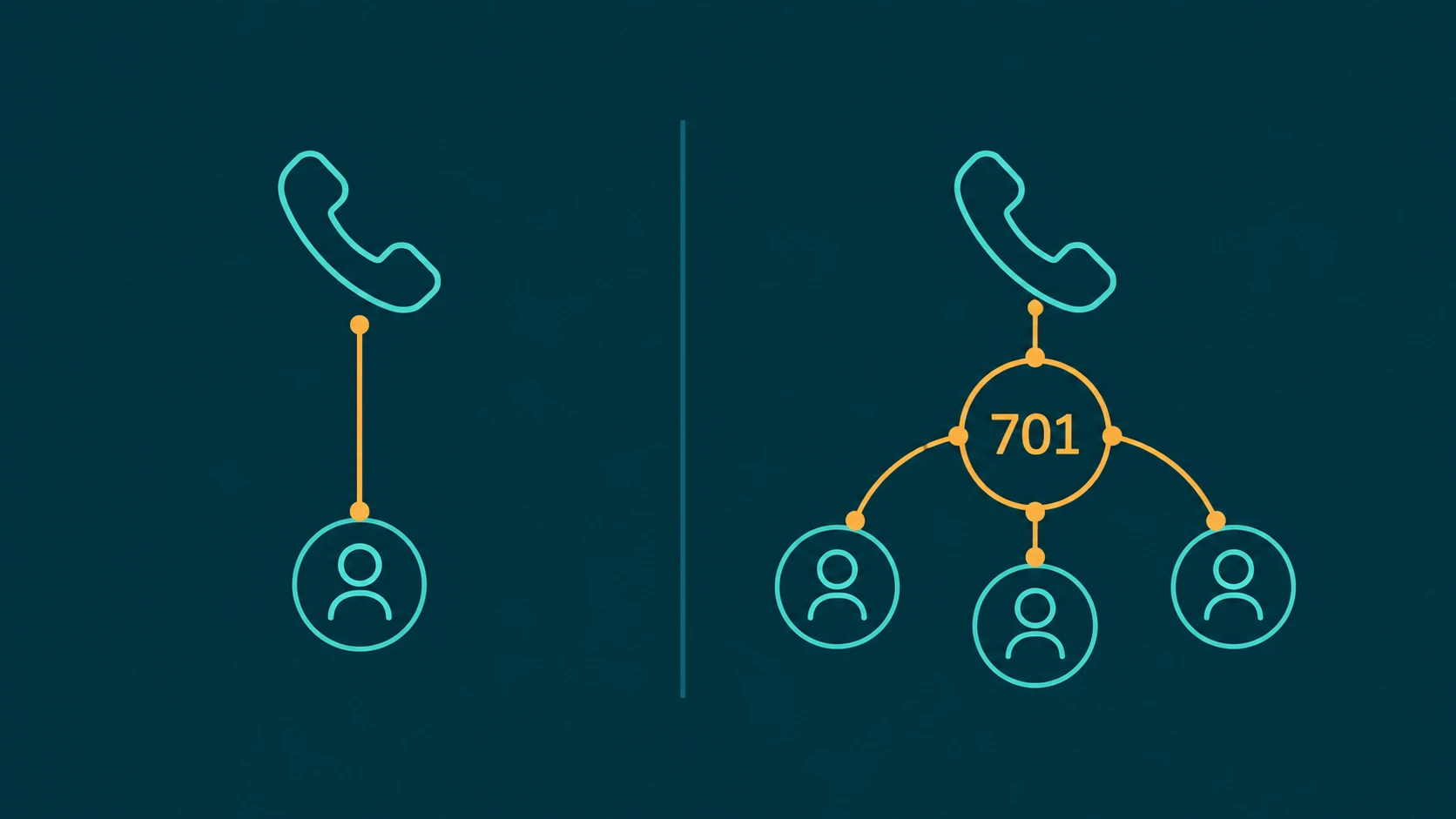
Definition: Call Hold temporarily suspends an active call on the original agent's line; only that agent can resume it. Call Park places a call into a numbered orbit slot managed by the PBX — any authorized agent on the system can retrieve the parked call by dialing the orbit number. The key distinction: hold is private and agent-locked; park is shared and retrievable by anyone with access.
How Call Hold Works
When an agent presses the hold button on their desk phone, softphone, or UCaaS client, the active call is suspended on that specific line or extension. The agent's phone retains ownership of the call. The caller hears hold music or a comfort tone configured by the system administrator, but the call remains bound to the agent who initiated the hold.
No other agent can pick up that held call. If the original agent logs off, their session ends, or they simply never resume the call, the caller will eventually hang up. Most PBX and UCaaS platforms do not enforce a recall timeout for held calls — the call stays locked indefinitely until the original agent takes it back or the caller disconnects. Some systems allow configuring a ring-back alert after a set period to remind the agent a call is waiting, but this varies by platform and is typically an optional reminder rather than an automatic recall.
Hold is the right tool for brief, agent-controlled pauses. An agent who needs thirty seconds to look up an account, check a policy, or finish a note uses hold. The caller is not going anywhere, and the agent will return. The scenario is time-bounded and agent-specific. For more on how call handling fits into a broader business phone system, the mechanics are covered in detail there.
How Call Park Works
Call Park is a PBX and UCaaS feature that operates at the call control layer. When an agent parks a call, the PBX assigns the call to a numbered orbit slot — a virtual holding position on the system. Common orbit numbering runs from 700 to 709, though the exact range is configured by the system administrator and varies by platform. Once parked, the original agent's line is freed. They can take another call, walk across the building, or hand off verbally without being tethered to that call.
Any agent authorized on the system can retrieve the parked call by dialing the orbit number. The retrieval method is typically DTMF-based — the agent dials the orbit number (for example, 701) from any phone on the system — or soft-key driven on a UCaaS client. The call connects to whoever dials the orbit, not to the original parker.
From a technical standpoint, Call Park is not a SIP-level primitive. It is a call control feature implemented by the PBX or UCaaS platform, using the platform's own signaling to place the call into a holding state associated with the orbit slot. The SIP session may remain active between the caller and the platform while in park. Park is entirely managed by the system's call control layer, not by the physical or virtual phone device.
Park Orbits and Numbering
A park orbit is a numbered slot that acts as a temporary address for a parked call. When a call is placed into orbit 701, any agent who dials 701 retrieves it. The PBX tracks which orbits are occupied and which are available. In a system with orbits 700 through 709, up to ten calls can be simultaneously parked. If all orbits are occupied and an agent attempts to park another call, the park will fail — the agent must hold the call conventionally or wait for an orbit to open.
In environments that use overhead paging, the orbit number becomes a coordination mechanism. An agent who parks a call at orbit 703 can broadcast over the intercom: "John, you have a call parked at 703." John walks to the nearest phone, dials 703, and picks up the caller — regardless of where John was when the page went out. This workflow is common in warehouses, retail floors, auto dealerships, and healthcare environments where staff move between stations throughout the day.
Some systems support named or dedicated park orbits — specific orbits reserved for specific departments or individuals — so that an agent's direct park slot is always predictable. Others use dynamic assignment, where the PBX chooses the next available orbit automatically and displays the orbit number on the agent's screen for them to announce. The implementation details depend on the platform.
Recall on Timeout: A Critical Difference
One of the most operationally significant differences between hold and park is what happens when no one retrieves the call.
With hold, there is typically no automatic recall mechanism. The call sits on the agent's line until the agent returns to it or the caller gives up and hangs up. The system does not automatically route the call elsewhere or ring back anyone except the holding agent (and only if the platform's optional hold reminder is configured).
With park, most PBX and UCaaS platforms enforce a recall timeout. If no agent retrieves a parked call within a configured period — commonly between 60 and 180 seconds — the PBX recalls the call. The recall behavior is typically one of the following: the call rings back to the original parker, the call routes to a designated overflow destination such as a queue or voicemail, or the system escalates per a configured policy. The recall timeout prevents callers from being permanently stranded in an orbit that no agent is aware of or has forgotten to retrieve.
This is why park workflows require communication. An agent who parks a call and does not announce or hand off the orbit number creates a situation where the recall timeout becomes the safety net — not the ideal outcome. The recall brings the call back but may surprise both the original parker and the caller.
Comparison: Call Hold vs Call Park
| Feature | Call Hold | Call Park |
|---|---|---|
| Who can retrieve | Only the original agent | Any authorized agent on the system |
| Line freed after action | No — call stays on agent's line | Yes — agent's line is freed immediately |
| Caller experience | Hold music or tone | Hold music or tone (identical) |
| Retrieval method | Agent resumes from their own line | Any agent dials the orbit number (e.g., 701) |
| Recall on timeout | Typically none — call waits indefinitely | Yes — PBX recalls after 60–180 seconds (configurable) |
| Overhead paging use | Not applicable — only one agent involved | Common — "Call parked at 701, line 1" |
| SIP-level feature | No — PBX/UCaaS call control layer | No — PBX/UCaaS call control layer |
| Best for | Brief pause while agent checks something | Routing a caller to someone at another station |
Use Cases for Call Hold
Hold is the correct choice when the pause is brief, agent-controlled, and does not require anyone else to pick up the call. Typical scenarios include:
- Account lookup: An agent asks the caller to hold for thirty seconds while pulling up their account in the CRM before continuing the conversation.
- Consulting a supervisor: An agent places a caller on hold to ask a supervisor a quick question before returning with an answer. For a more involved consultation where the supervisor might need to speak with the caller directly, a warm transfer is more appropriate.
- System lag: An agent is waiting for a slow database query or document to load and doesn't want the caller to hear typing or wait noise in the background.
- Processing a request: Completing a form, submitting an order, or processing a payment while the caller stays connected but the agent needs silence to focus.
In all of these cases, the original agent will return to the call. No other agent is involved, and there is no need to free the line or coordinate across the team.
Use Cases for Call Park
Park is appropriate when the call needs to be handed off to someone who may not be at their own phone, when the original agent needs to be freed entirely, or when coordination across a team or space is required. Typical scenarios include:
- Routing to a mobile person: A receptionist parks a call at orbit 702 and pages over the intercom for a technician who is somewhere in the warehouse. The technician picks up the nearest phone and dials 702.
- Retail and dealership environments: A sales associate parks a call and walks the floor to find a specialist. The specialist picks it up from a nearby station without the associate needing to physically return to their desk.
- Healthcare facilities: A nurse parks a call from a patient family member and pages the attending physician by name and orbit number. The physician retrieves the call from whatever phone is nearest.
- Shared agent pools: Any agent in a group can pick up a parked call, making park useful when the next available agent — rather than a specific agent — should handle the continuation of a call.
- Freeing the original agent: If the original agent needs to take a new incoming call immediately, parking the existing call frees their line without abandoning the caller. This is especially useful in environments without call queues handling overflow automatically.
How Park and Hold Relate to Transfers
Both hold and park can appear in workflows that involve transferring calls, but they serve different roles. A warm transfer — where the agent briefs the receiving party before handing off — typically uses hold to keep the caller waiting while the agent speaks with the receiving agent on a separate line. Park is not usually involved because the handoff target is specific and the coordination happens directly, not through an orbit.
Park is more closely related to an indirect handoff: park the call, announce the orbit, and let the right person retrieve it without the original agent staying involved. This is similar in spirit to a transfer but without a direct agent-to-agent conversation before the handoff. It works when the target is not at a desk and cannot be placed in a direct call leg with the original agent. The distinction between transfer approaches is covered in detail in the article on warm transfer vs cold transfer.
Choosing Between Hold and Park
The decision point is straightforward: will the original agent return to this call, or does someone else need to pick it up?
- If you will return to the call yourself within a short time, use hold.
- If someone else needs to pick this call up — especially someone who is not at their own phone — use park.
- If the call needs to go to a specific agent who is at their desk and available — for example through skills-based routing — a transfer is more direct than park.
- If the call needs to wait for the next available agent in a pool, a queue is the right structure rather than park. See the article on call queues for how queue-based distribution works.
Park is not a replacement for queues in high-volume environments. Orbits are finite — a system with ten orbits can handle ten simultaneous parked calls. A contact center handling dozens or hundreds of concurrent calls needs a proper queue infrastructure with routing logic, not a bank of manually managed park slots.
Park is most powerful in smaller team environments or for specific cross-location workflows where a caller needs to reach someone who may not be reachable by a direct transfer. It is a coordination tool as much as a call control feature.